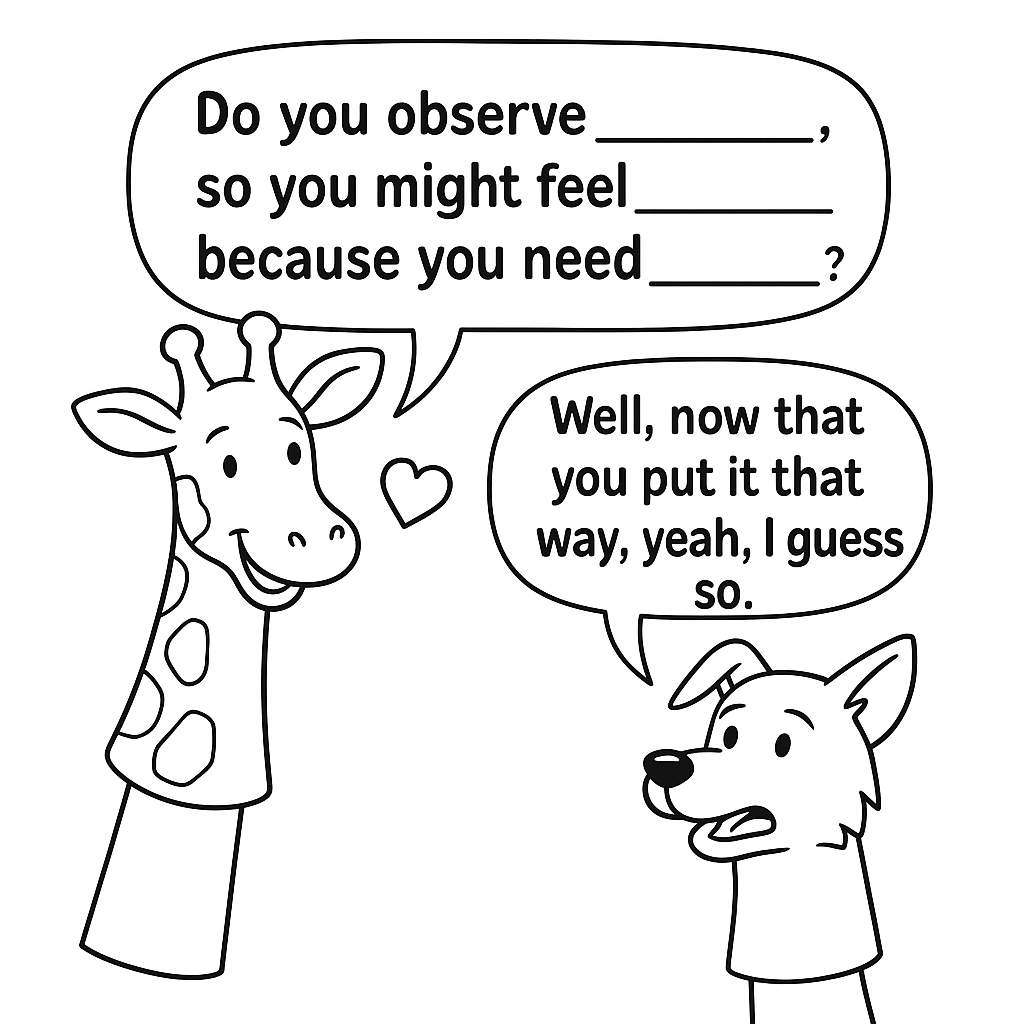
“Are you feeling __________ because you’re needing __________?”
Dr. Higgins' NVC Summary, Cartoon, & Links to more resources & videos
09Dec
Nonviolent Communication — Summary
By Marshall B. Rosenberg, PhD
Themes of the Book
All human behavior is an attempt to meet basic universal needs.
Compassion arises when we connect with these needs — in ourselves and others.
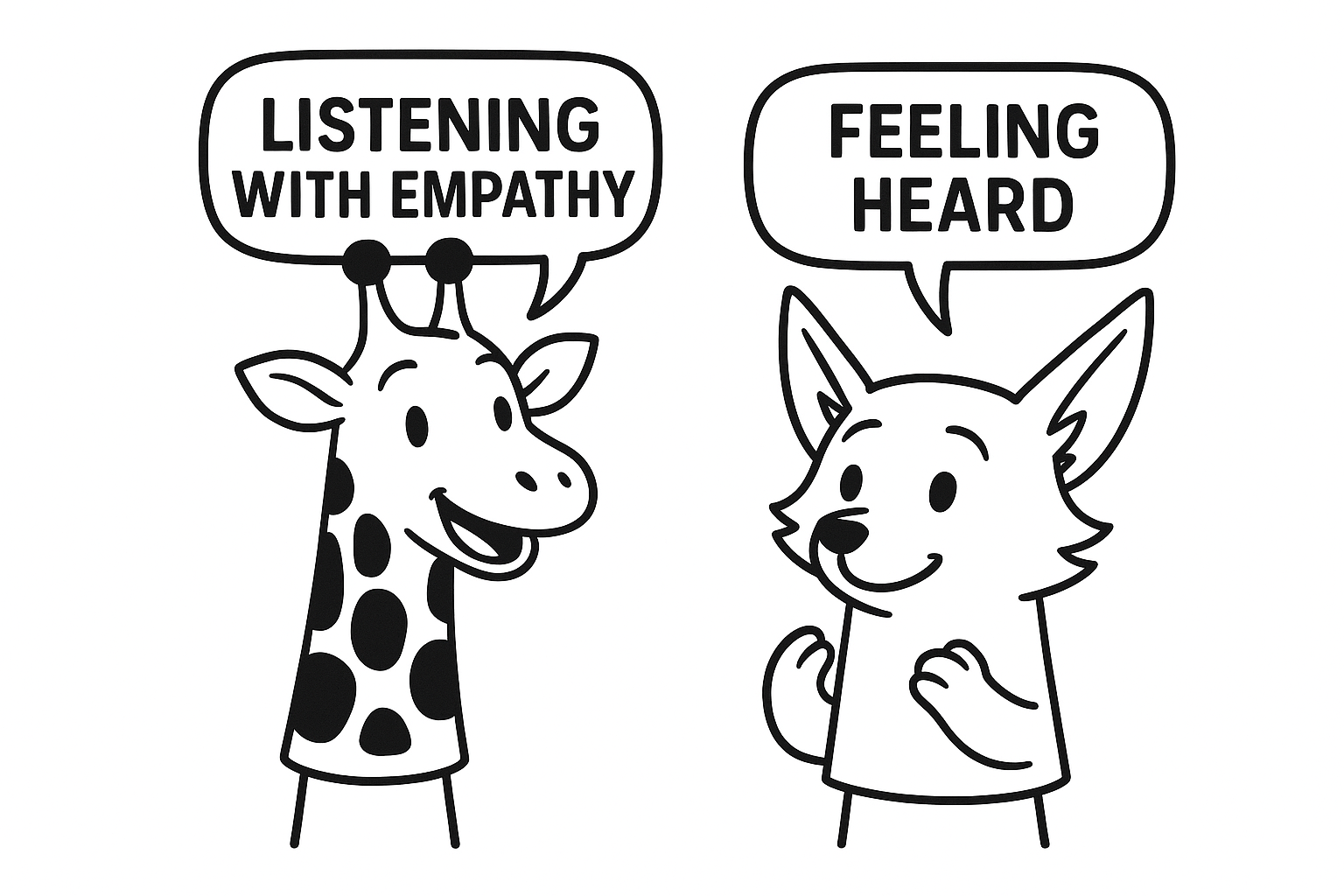
Conflict dissolves when people feel heard, understood, and respected.
NVC is both a compassionate communication framework and a consciousness: a shift from coercion and judgment to empathy and honesty.
The ultimate goal is to create a quality of connection where everyone’s needs matter.
Compassionate Communication can enhance personal connections, peace, and wellbeing.
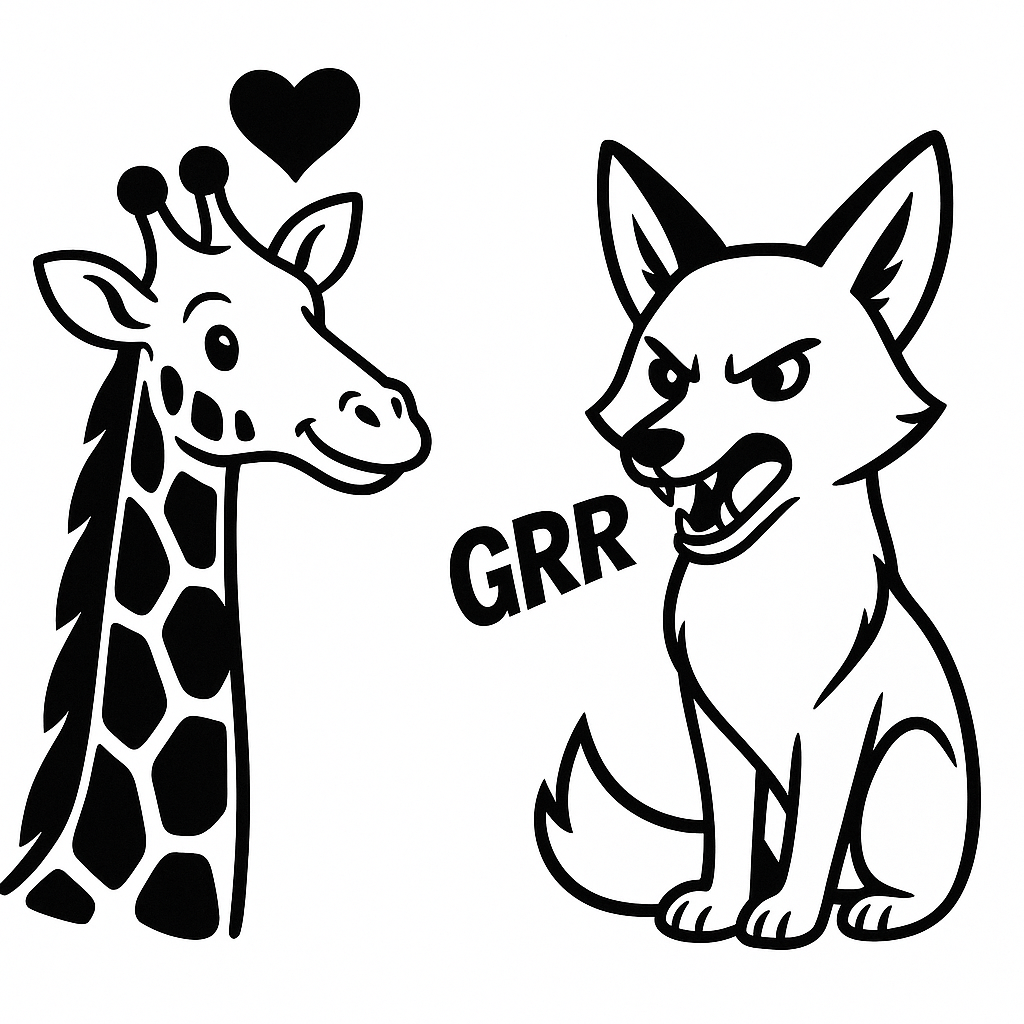
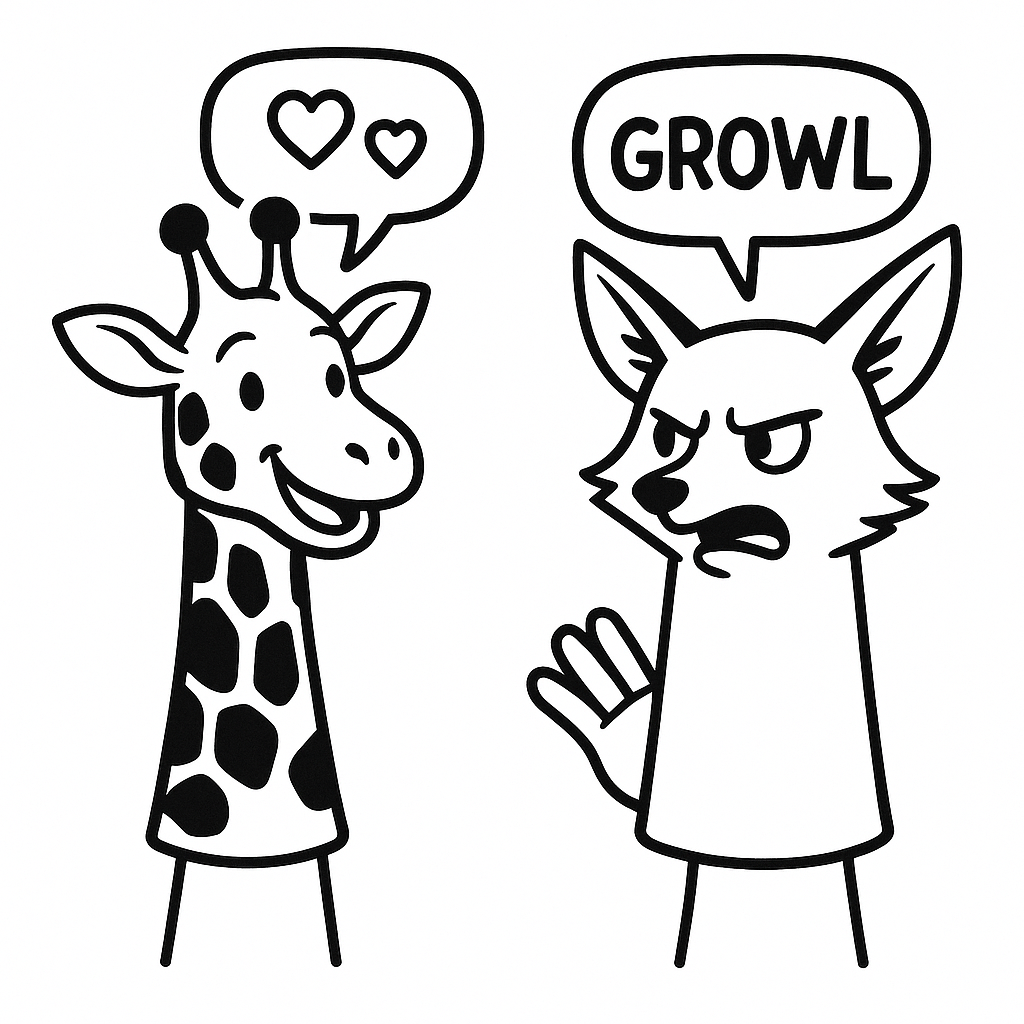
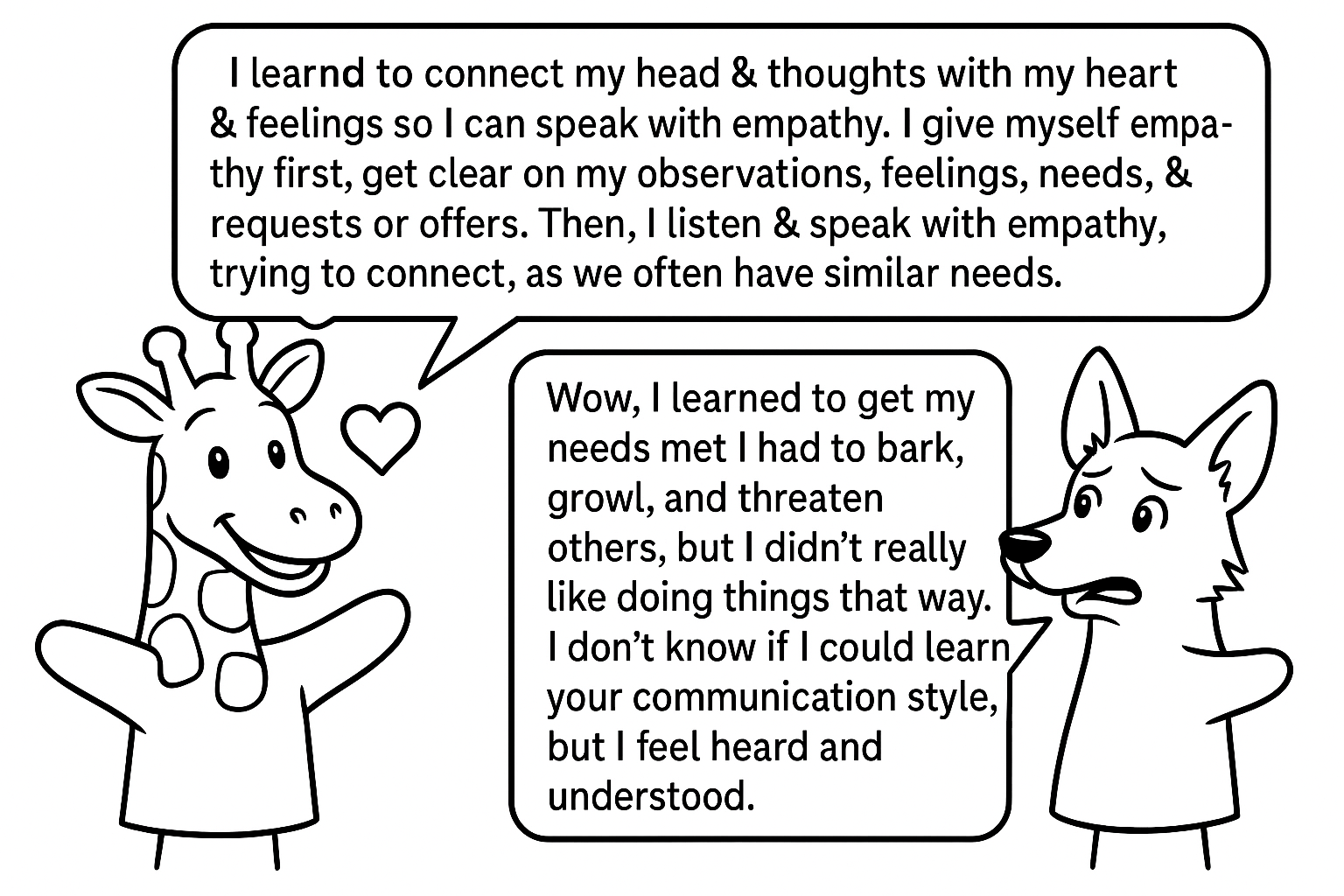
The GIRAFFE is noted as the compassionate communicator who speaks from the head and heart as the mammal with a very large heart and a very long way to travel between head and heart due to long neck, giraffe has worked hard to learn compassionate heartfelt wise communication. Giraffe gives self-empathy, other empathy, and then expresses 1) nonjudgmental observations, 2) personal feelings or emotions, 3) underlying universal needs we all have, and then 4) can make a genuine reasonable request or meaningful connection-building comment. The 4-part NVC is asserting with an "I" statement: my observations, feelings, needs, and requests for change and/or connection.
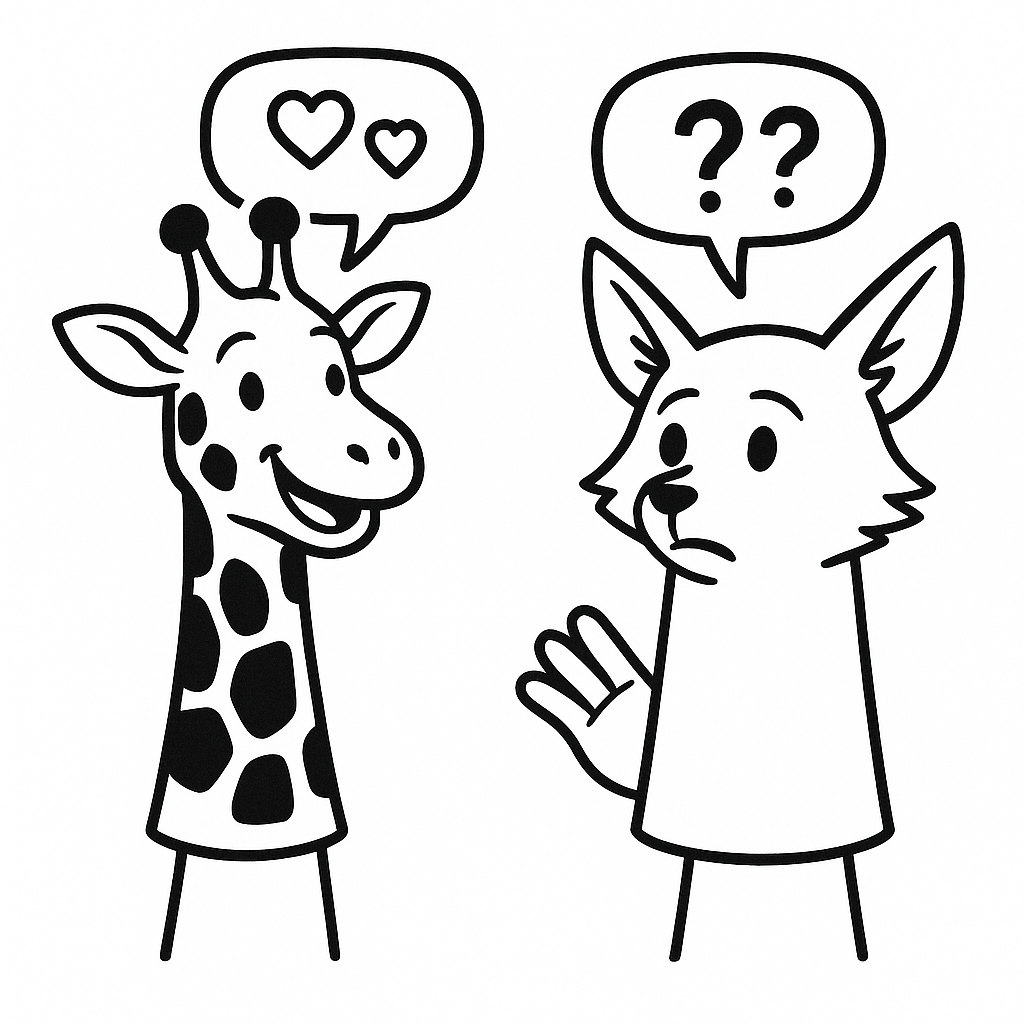
The jackal is noted to bark and growl as he has not learned compassionate communication yet. From fear and defensiveness, he has resorted to aggression and/or hostile means to get his needs met in the past. Jackal can and is able to learn to speak Giraffe - once he feels safe and heard and understood through empathy and compassion. All his behavior is actually just a way to be heard and try to get basic needs met. Jackal is not bad - just misunderstood and needing patience and empathy to be taught compassionate communication. He has yet to learn that his needs can be met through a new language of the heart.
The Giraffe represents:
Symbol of Heartfelt Communication: The giraffe is chosen as the symbol of compassionate heartfelt communication because it has the largest heart of any land mammal, representing empathy and genuine deep connection. Additionally, due to its long neck, it has had to work very hard to connect the Wise Balanced Mind (head / thoughts) to the heart of feelings, emotions, love to move towards its mouth to speak the language of the heart/mind connection.
Language of Loving Compassion for All Life: Represents a way of compassionate communicating that is centered on understanding and connecting with the feelings and needs of oneself and others. The giraffe seeks clarity, connection, and mutually beneficial solutions that often result in harmony and deep understanding and appreciation of oneself and others, cooperating instead of competing or arguing / fighting.
Empathetic, Attentive Listening: The giraffe listens with full presence, trying to understand the underlying feelings and needs with acceptance, unconditional positive regard, understanding, compassion, without judgment or evaluation.
Prosperity & Abundance Mindset: Operates from a mindset of abundance, generosity, sharing in prosperity, believing that everyone's needs can be met.
The Jackal represents:
Authentic, Honest Expression: When speaking, the giraffe expresses its true (sometimes underlying) feelings and needs (sometimes underlying or core needs often subconsciously forgotten) openly without blame, demand, or criticism.
Symbol of Defense Mechanisms, Aggressive or Passive Aggressive, Life-Disconnected Communication: Represents a more habitual way of thinking and communicating that often leads to blame, judgment, and misunderstanding.
Language of Intellectualizing, Rationalizing MInd / Head: The jackal tends to analyze, categorize, criticize, or compare, which can result in defensive reactions or disconnection.
Reactive Listening: The jackal often hears criticism and demands, even if none were intended. It may react defensively or aggressively.
Fearful, Greedy, Scarcity, Loss Mindset: Operates from a mindset of scarcity, seeing situations as zero-sum where one's gain is another's loss.
Demanding Expression: When speaking, the jackal often expresses its viewpoints through judgments, blame, demands, or evaluations.
Nonviolent Communication — Chapter-by-Chapter Summary
Chapter 1 — Giving From the Heart
Focus: The purpose and spirit of Nonviolent Communication (NVC).
Key themes:
NVC is a “language of life” based on compassion and mutual giving.
Human beings naturally enjoy giving when it comes from empathy, not obligation or guilt.
Introduces the four components of NVC:
Observation
Feeling
Need
Request
Distinguishes “jackal language” (judgment, blame) from “giraffe language” (needs-based, compassionate).
Representative quote:
“What I want in my life is compassion, a flow between myself and others based on a mutual giving from the heart.”
Chapter 2 — Communication That Blocks Compassion
Focus: The habits of speech and thinking that disconnect us.
Key themes:
Moralistic judgments (right/wrong, good/bad) block connection.
Comparisons create shame, envy, and dissatisfaction.
Denial of responsibility (“I had to,” “They made me…”) hides our choices.
“Life-alienating communication” includes criticism, labeling, diagnosis, and deserving language.
Quote:
“Judgments of others are alienated expressions of our own unmet needs.”
Chapter 3 — Observing Without Evaluating
Focus: The difference between factual observation and judgment.
Key themes:
Observations describe what we can see or hear.
Evaluations, even subtle ones, trigger defensiveness.
Clear observations create the foundation for honest communication.
Example:
Observation: “You arrived 20 minutes after the agreed time.”
Evaluation: “You’re always late.”
Chapter 4 — Identifying and Expressing Feelings
Focus: Connecting with and naming one’s emotions.
Key themes:
Distinguishing real feelings from thoughts disguised as feelings (“I feel ignored”).
Expanding emotional vocabulary to express oneself accurately.
Feelings point toward our needs — they are signals.
Quote:
“Feelings are indicators of our needs.”
Chapter 5 — Taking Responsibility for Our Feelings
Focus: Our emotions arise from our own needs, not from others’ actions.
Key themes:
Others’ actions may stimulate feelings, but they do not cause them.
Feelings stem from whether our needs are met or unmet.
Four ways to respond to negative messages:
Blame self
Blame other
Sense own feelings/needs
Sense other’s feelings/needs
The developmental path: emotional slavery → obnoxiousness → emotional liberation.
Quote:
“What others say and do may be the stimulus, but never the cause, of our feelings.”
Chapter 6 — Requesting That Which Would Enrich Life
Focus: Making clear, compassionate, doable requests.
Key themes:
Requests must be stated in positive action language (“what you do want”).
A request becomes a demand when we react negatively to a refusal.
Clarity removes guessing and prevents resentment.
Check for understanding (“Could you tell me what you heard me say?”).
Chapter 7 — Receiving Empathically
Focus: Listening deeply to others.
Key themes:
Empathy requires presence, not fixing or advising.
Listen for the other person’s feelings and needs, even if they speak in blame or criticism.
Reflect back what you hear to ensure understanding.
Empathy restores connection, even in tense conversations.
Quote:
“Empathy calls upon us to empty our mind and listen to others with our whole being.”
Chapter 8 — The Power of Empathy
Focus: Empathy as a transformative force.
Key themes:
Empathy helps dissolve anger, shame, and misunderstanding.
People often need empathy before they can hear advice or engage in problem-solving.
Empathy for silence, reluctance, or “no” deepens trust.
Several real-life examples show empathy defusing conflict.
Chapter 9 — Connecting Compassionately With Ourselves
Focus: Self-empathy and self-forgiveness.
Key themes:
Transforming inner criticism by uncovering unmet needs.
Mourning choices that did not meet our needs — without self-blame.
Choosing actions based on joy rather than obligation (“Don’t do anything that isn’t play!”).
Self-empathy increases ability to offer authentic empathy to others.
Chapter 10 — Expressing Anger Fully
Focus: Understanding anger as a signal of unmet needs.
Key themes:
Anger arises from judgmental thinking, not from external triggers.
Steps for expressing anger constructively:
Pause and breathe
Identify thoughts and judgments
Connect with underlying needs
Express those needs clearly, without blame
Taking time to return to empathy when in conflict.
Quote:
“The cause of anger lies in our thinking—in thoughts of blame and judgment.”
Chapter 11 — Conflict Resolution and Mediation
(In some editions this material is woven into other chapters.)
Focus: Using NVC to resolve conflicts and support mediation.
Key themes:
The goal is mutual understanding and meeting everyone’s needs.
Identify feelings and needs for each party.
Create strategies that honor all needs rather than compromise or coercion.
Mediators model empathy and clarity.
Chapter 12 — The Protective Use of Force
Focus: Understanding when force can be used without violence.
Key themes:
Violence aims to punish; protective force aims to prevent harm.
Used only when dialogue is impossible or immediate safety is at risk.
Guided by awareness of needs, not judgments about people being “bad.”
Chapter 13 — Liberating Ourselves and Counseling Others
Focus: Applying NVC in personal growth and helping relationships.
Key themes:
Understanding habitual patterns and conditioning.
Helping others connect feelings → needs → requests.
How “jackal education” encourages fear, guilt, shame; NVC supports autonomy and compassion.
Chapter 14 — Expressing Appreciation in Nonviolent Communication
Focus: Appreciation as a needs-based expression.
Key themes:
Genuine appreciation contains three parts:
What the person did
How it made you feel
What need it met
Appreciation is not flattery; it is mindful acknowledgment.
Helps strengthen relationships by making needs visible.
Quote:
“Receiving appreciation in NVC lets us stay connected to the beauty of the needs that have been met.”
Key Ideas:
All human behavior is an attempt to meet basic universal needs.
Compassion arises when we connect with these needs — in ourselves and others.
Conflict dissolves when people feel heard, understood, and respected.
NVC is both a communication framework and a consciousness: a shift from coercion and judgment to empathy and honesty.
The ultimate goal is to create a quality of connection where everyone’s needs matter.
The Giraffe and the Jackal....

Marshall Rosenberg used two animals to demonstrate the two types of communication in his book:
References -
The Center for Nonviolent Communications
Unlocking Self Understanding with NVC
** From my former NVC mentor Kelly Bryson, MFT, and his excerpts from "Don't Be Nice, Be Real" and his article on "Compassionate Communications: Confessions of a Cling-On":
Here’s a North Star for finding the heart of honesty within oneself:
When I observe (or remember, or hear, or smell)......................................
I feel......................................
Because I was (or am) wanting.......................
Would you tell me if you’re willing to............................................
This is a way of focusing my thinking and communicating my truth accurately. Notice that the grammar of the sentence allows for no judgment of the other and requires that the speaker take responsibility for their feelings and needs. They take responsibility for their feelings by declaring that their feelings are being caused by the condition of their needs. They do not say that their feelings are caused by the other person. If their needs are met, good feelings are produced, if not, bad or uncomfortable feelings. They say “When you didn’t come over, I was sad because I was wanting some company, could we get together tomorrow?
”If can’t be in touch with you if I’m not in touch with me. I can’t see you when I’m looking for myself. So if I seem to pass you blind, please try to keep in mind, It isn’t you, it’s me I cannot find." by Ruth Bebemeyer
Kelly Bryson also noted: Here’s a map which uses the essence of empathy to find and feel the heart of the other:
When you see (or remember, or heard) ...............
Did you feel................................................
Because you were (or are) wanting ...................?
And would you like me to tell you if I am willing to .....................................?
Kelly Bryson noted: As soon as I turn my attention to what my partner is reacting to, feeling, needing and requesting it’s a different world. Instead of being caught in the control of her Cling-on tractor beam about to suck me into the Black Hole of her endless need, I’m being invited into the Secret Garden of a beautiful wonderchild, to play, and to give and receive nurturance. As I develop my skill to listen to and from my heart (my feelings and needs) I no longer see men and women, needy Cling-ons or detached Vulcans; only sweet sentient beings offering to meet my needs or requesting that I meet theirs’. And when their is choice, all needs are beautiful.
"See me beautiful, look for the best in me. That’s what I really am and what I want to be. It may be hard to find, and it may take some time, but see me beautiful. See me beautiful, each and every day. Could you take a chance? Could you find a way? To see me shining through, in everything I do, and see me beautiful?" by Red Barber
** Here are some other useful files related to NVC including info on a game called GROK to practice NVC skills.
When deciding to commit to something remember an NVC motto that you ask yourself if you say "yes" when to do so brings you the same level of joy as feeding hungry ducklings!
1. QUICK NVC SELF-EXPRESSION PAGE
Use this when you need to express something clearly and calmly.
Observation (What I saw/heard):
→ __________________________________
Feeling (Emotion word only):
→ __________________________________
Need (Universal human need):
→ __________________________________
Request (Clear, doable action):
→ __________________________________
Template:
“When I saw/heard __________, I felt __________ because I need __________. Would you be willing to __________?”
2. EMPATHY MAP (FOR UNDERSTANDING OTHERS)
Tap through these prompts when listening to someone upset. What they observed:
→ __________________________________
What they might feel:
→ __________________________________
What they might need:
→ __________________________________
What they might request:
→ __________________________________
“Are you feeling __________ because you’re needing __________?”
3. ANGER TRANSFORMATION
Use this to de-escalate internally before speaking.Trigger (What happened):
→ __________________________________
My judgmental thoughts:
→ __________________________________
My underlying needs:
→ __________________________________
A calmer way to express this:
→ __________________________________
→ __________________________________
4. SELF-EMPATHY POCKET CHECK-IN
Fast grounding tool for stressful moments.Feeling right now:
→ __________________________
Need underneath:
→ __________________________
Kind request of myself:
→ __________________________
“I’m noticing I feel __________ because I’m needing __________. I can offer myself __________.”
5. APPRECIATION IN NVC
(SHORT VERSION)
Use for gratitude, relationships, or positive communication.1. What they did:
→ __________________________________
2. How you felt:
→ __________________________________
3. What need it met:
→ __________________________________
Template:
“When you __________, I felt __________ because it met my need for __________.”
6. REPAIRING A CONFLICT
Use after an argument or rupture.
1. What I said/did:
→ __________________________________
2. What they may have felt:
→ __________________________________
3. What they may have needed:
→ __________________________________
4. My intention:
→ __________________________________
5. My request for going forward:
→ __________________________________
6. What I’d appreciate from them:
→ __________________________________
Script Example:
“When I said/did __________, I imagine you felt __________ because you needed __________.
My intention was __________.
Going forward, could we __________? I would appreciate __________.”
7. NVC DAILY PRACTICE
Morning Check-In
• Feeling: __________________
• Need Today: ______________
• One Request of Myself: ____
Evening Reflection
• What went well today? ______
• Moments of unmet needs? ___
• What would help tomorrow? __
8. BASIC NEEDS
Here are some commonly shared Basic Needs:
Connection:
Love • Support • Belonging • Understanding • Acceptance • Validation • Compassion • Authenticity
Autonomy:
Choice • Freedom • Personal Space • Privacy • Dignity • Respect • Individuation
Meaning:
Purpose • Growth • Wisdom • Education • Fulfillment • Spirituality • Values • Passion • Ethics • Goals • Visions
Peace:
Serenity • Tranquility • Calmness • Quiet • Relaxation • Order • Balance • Meditation
Physical:
Rest • Nourishment • Safety • Exercise • Hydration • Health Care • Hygiene • Clean Air • Sanitation
Play:
Joy • Humor • Fun • Music • Art • Dance • Sports • Creativity • Interactions with nature and pets
LINKS TO LEARN MORE:
• NVC Giraffe Language Videos with Marshall Rosenberg
NVC Interactive Exercises and Games:
NVC Dance Floors - Interactive Exercise for all ages
• GROK - a game to practice NVC Giraffe Language / Compassionate Communications
• NVC for the Next Generation - with interactive tools & games like Grok for the computer and more
DR. HIGGINS' BASIC NVC GIRAFFE &JACKAL PUPPET CARTOON:
*** Download a copy of Kelly Bryson's Compassionate Communications - confessions of a Cling-On below. Also, check out his book on Amazon, Don't Be Nice, Be Real an NVC primer.
Download FilePDF • 53KB
Also, Download a copy of this page here:
PDF - Higgins NVC Summary
Comments