NVC Book Summary
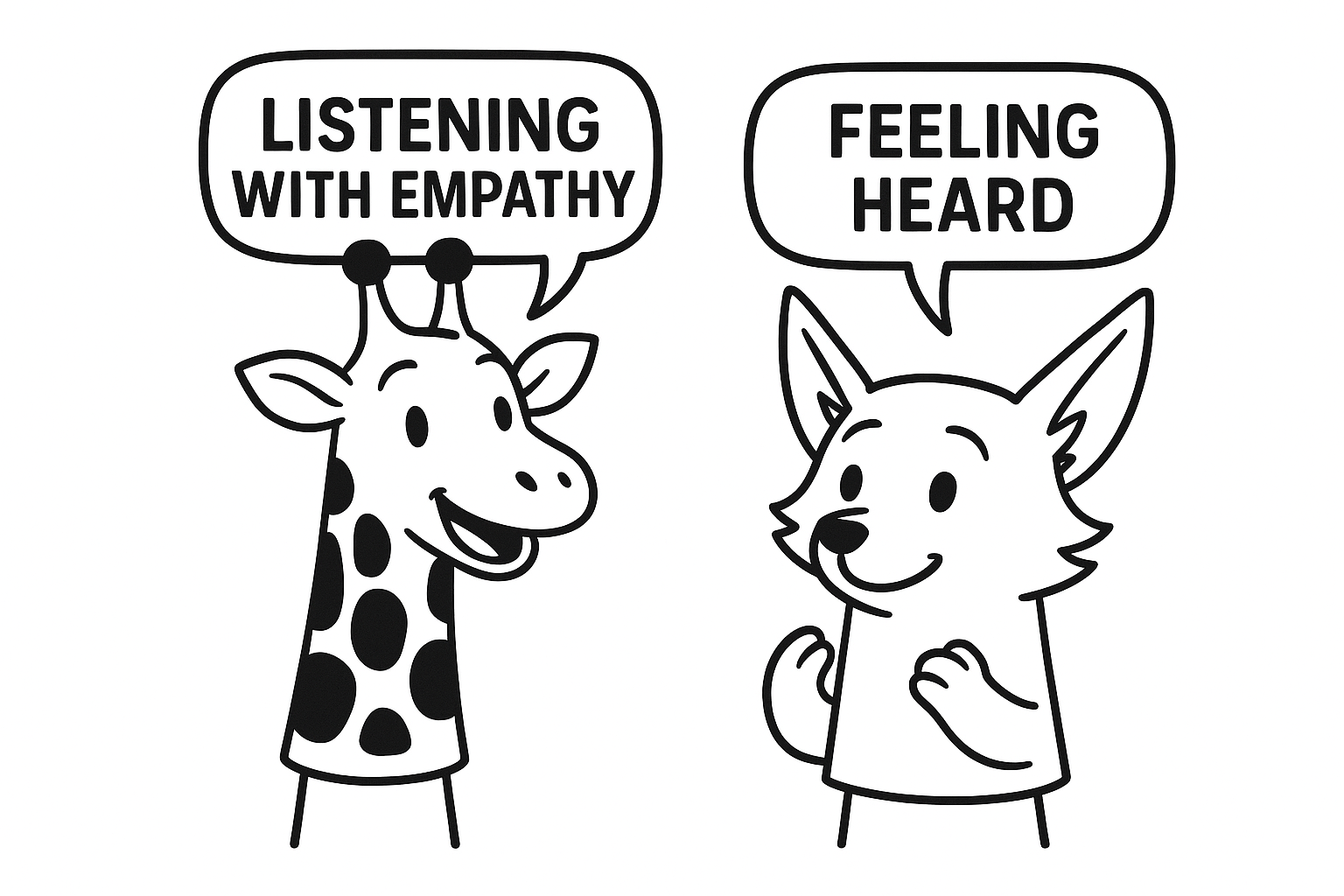
Nonviolent Communication — Chapter-by-Chapter Summary
By Marshall B. Rosenberg, PhD
Chapter 1 — Giving From the Heart
Focus: The purpose and spirit of Nonviolent Communication (NVC).
Key themes:
- NVC is a “language of life” based on compassion and mutual giving.
- Human beings naturally enjoy giving when it comes from empathy, not obligation or guilt.
- Introduces the four components of NVC:
- Observation
- Feeling
- Need
- Request
- Distinguishes “jackal language” (judgment, blame) from “giraffe language” (needs-based, compassionate).
Representative quote:
“What I want in my life is compassion, a flow between myself and others based on a mutual giving from the heart.”
Chapter 2 — Communication That Blocks Compassion
Focus: The habits of speech and thinking that disconnect us.
Key themes:
- Moralistic judgments (right/wrong, good/bad) block connection.
- Comparisons create shame, envy, and dissatisfaction.
- Denial of responsibility (“I had to,” “They made me…”) hides our choices.
- “Life-alienating communication” includes criticism, labeling, diagnosis, and deserving language.
Quote:
“Judgments of others are alienated expressions of our own unmet needs.”
Chapter 3 — Observing Without Evaluating
Focus: The difference between factual observation and judgment.
Key themes:
- Observations describe what we can see or hear.
- Evaluations, even subtle ones, trigger defensiveness.
- Clear observations create the foundation for honest communication.
Example:
- Observation: “You arrived 20 minutes after the agreed time.”
- Evaluation: “You’re always late.”
Chapter 4 — Identifying and Expressing Feelings
Focus: Connecting with and naming one’s emotions.
Key themes:
- Distinguishing real feelings from thoughts disguised as feelings (“I feel ignored”).
- Expanding emotional vocabulary to express oneself accurately.
- Feelings point toward our needs — they are signals.
Quote:
“Feelings are indicators of our needs.”
Chapter 5 — Taking Responsibility for Our Feelings
Focus: Our emotions arise from our own needs, not from others’ actions.
Key themes:
- Others’ actions may stimulate feelings, but they do not cause them.
- Feelings stem from whether our needs are met or unmet.
- Four ways to respond to negative messages:
- Blame self
- Blame other
- Sense own feelings/needs
- Sense other’s feelings/needs
- The developmental path: emotional slavery → obnoxiousness → emotional liberation.
Quote:
“What others say and do may be the stimulus, but never the cause, of our feelings.”
Chapter 6 — Requesting That Which Would Enrich Life
Focus: Making clear, compassionate, doable requests.
Key themes:
- Requests must be stated in positive action language (“what you do want”).
- A request becomes a demand when we react negatively to a refusal.
- Clarity removes guessing and prevents resentment.
- Check for understanding (“Could you tell me what you heard me say?”).
Chapter 7 — Receiving Empathically
Focus: Listening deeply to others.
Key themes:
- Empathy requires presence, not fixing or advising.
- Listen for the other person’s feelings and needs, even if they speak in blame or criticism.
- Reflect back what you hear to ensure understanding.
- Empathy restores connection, even in tense conversations.
Quote:
“Empathy calls upon us to empty our mind and listen to others with our whole being.”
Chapter 8 — The Power of Empathy
Focus: Empathy as a transformative force.
Key themes:
- Empathy helps dissolve anger, shame, and misunderstanding.
- People often need empathy before they can hear advice or engage in problem-solving.
- Empathy for silence, reluctance, or “no” deepens trust.
- Several real-life examples show empathy defusing conflict.
Chapter 9 — Connecting Compassionately With Ourselves
Focus: Self-empathy and self-forgiveness.
Key themes:
- Transforming inner criticism by uncovering unmet needs.
- Mourning choices that did not meet our needs — without self-blame.
- Choosing actions based on joy rather than obligation (“Don’t do anything that isn’t play!”).
- Self-empathy increases ability to offer authentic empathy to others.
Chapter 10 — Expressing Anger Fully
Focus: Understanding anger as a signal of unmet needs.
Key themes:
- Anger arises from judgmental thinking, not from external triggers.
- Steps for expressing anger constructively:
- Pause and breathe
- Identify thoughts and judgments
- Connect with underlying needs
- Express those needs clearly, without blame
- Taking time to return to empathy when in conflict.
Quote:
“The cause of anger lies in our thinking—in thoughts of blame and judgment.”
Chapter 11 — Conflict Resolution and Mediation
(In some editions this material is woven into other chapters.)
Focus: Using NVC to resolve conflicts and support mediation.
Key themes:
- The goal is mutual understanding and meeting everyone’s needs.
- Identify feelings and needs for each party.
- Create strategies that honor all needs rather than compromise or coercion.
- Mediators model empathy and clarity.
Chapter 12 — The Protective Use of Force
Focus: Understanding when force can be used without violence.
Key themes:
- Violence aims to punish; protective force aims to prevent harm.
- Used only when dialogue is impossible or immediate safety is at risk.
- Guided by awareness of needs, not judgments about people being “bad.”
Chapter 13 — Liberating Ourselves and Counseling Others
Focus: Applying NVC in personal growth and helping relationships.
Key themes:
- Understanding habitual patterns and conditioning.
- Helping others connect feelings → needs → requests.
- How “jackal education” encourages fear, guilt, shame; NVC supports autonomy and compassion.
Chapter 14 — Expressing Appreciation in Nonviolent Communication
Focus: Appreciation as a needs-based expression.
Key themes:
- Genuine appreciation contains three parts:
- What the person did
- How it made you feel
- What need it met
- Appreciation is not flattery; it is mindful acknowledgment.
- Helps strengthen relationships by making needs visible.
Quote:
“Receiving appreciation in NVC lets us stay connected to the beauty of the needs that have been met.”
Overall Themes of the Book
- All human behavior is an attempt to meet basic universal needs.
- Compassion arises when we connect with these needs — in ourselves and others.
- Conflict dissolves when people feel heard, understood, and respected.
- NVC is both a communication framework and a consciousness: a shift from coercion and judgment to empathy and honesty.
- The ultimate goal is to create a quality of connection where everyone’s needs matter.
References
Marshall B. Rosenberg, Nonviolent Communication: A Language of Life, various editions, PuddleDancer Press.